This was one of the busiest weeks of the field season with a lot going on in the various excavations. The weather held steady all week with no rain and the nights getting warmer.
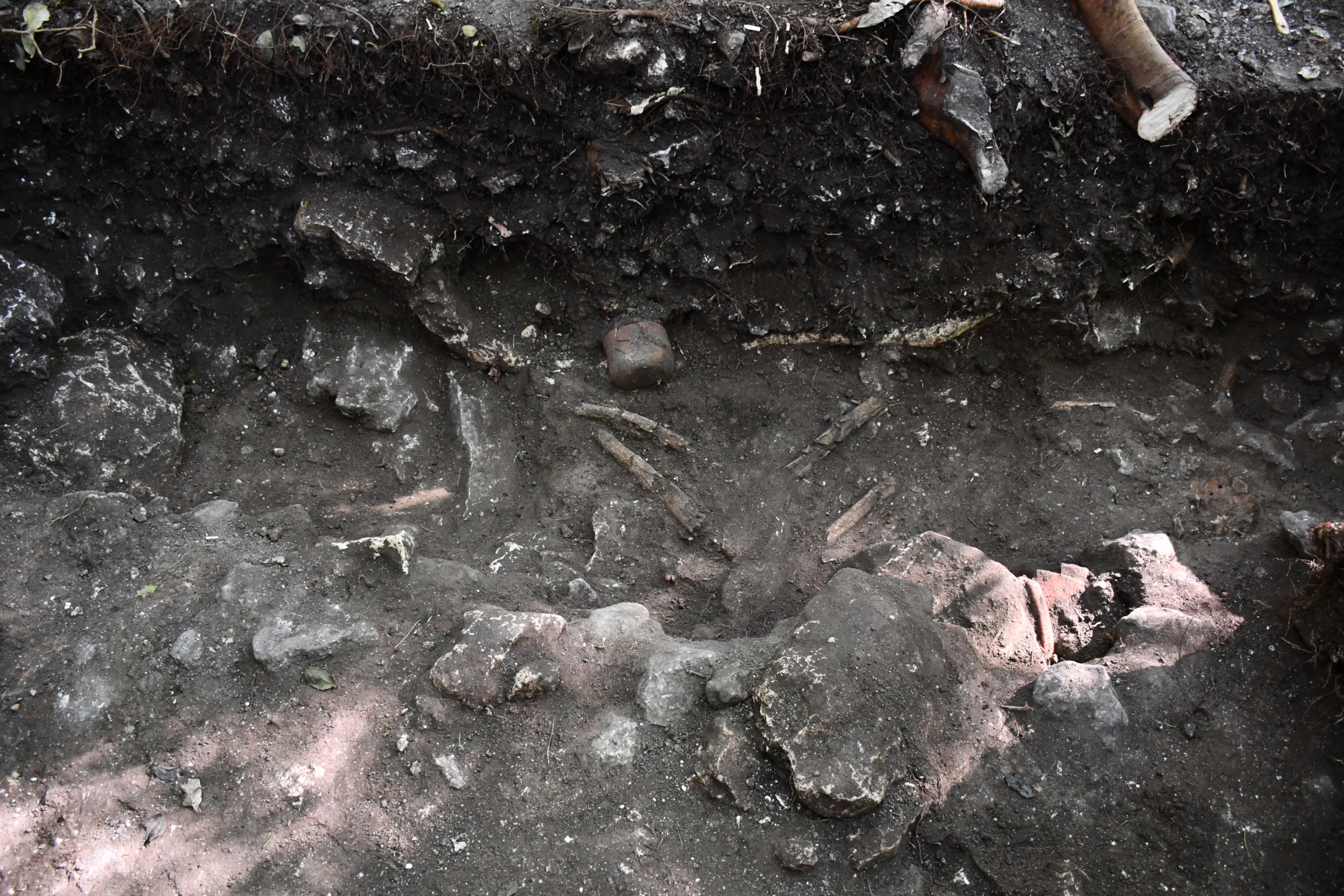
In Fresco residential group (C244B), most excavation focused on the western extent of the trench. The burial in front of the lowest step was fully excavated and removed. A southward extension was placed over the infilled tomb and then dug to show the full extent of the chamber, revealing an L-shaped bench, and showing a blocked doorway that articulated with the alleyway. Long bone was encountered on top of the bench, drawn, and removed. Next week the alley will be excavated. In front of the chamber, the floor between the front step and the second step was removed, revealing an earlier step and a good plaster floor. A skull cache and finger bowl were found beneath the floor on axis to the large tomb. The plaster floor that turned up to the earlier step revealed a cut that ran out the north side of the section and would have been under the lateral outset for the second upper step. We will more fully investigate this locus next week.
In Brie, excavation (C246B) proceeded with the recovery of multiple burials as well as a face cache. The axial excavation was dug to bedrock at the summit of the structure and revealed a construction wall that supported all the fill. The week began with the excavation of a set of slabs at the summit that were set directly above very fragmentary skeletal remains. Further excavation immediately west of this area found a box-like feature around two slabs that were set directly over the remains of a child. An extension south of this feature (outside of the axial trench) found a summit step that did not exist in the central investigation. Excavation in the fill to the west of the box found another set of four very large slabs that will be excavated next week. In the plaza area of Brie, a face cache and two children’s burials were found set directly into the plaza fill above a set of large slabs. Underneath the slabs were human skeletal remains; nothing accompanied the remains, so dating is problematic. The face cache dates to the late Late Classic.
In Hevarti, three excavations were worked on simultaneously. The original excavation (C245B), an axial trench over the northern building, was largely completed with the deep summit excavation going to bedrock and the front tomb being fully recorded. Excavations in the plaza part of this trench last week had revealed capstones and these were removed, revealing a body on its side with a bowl near one of the femurs. An extension was dug to the north of the axial trench to reveal a final capstone overlaying the skull. In the eastern excavation (C245C), the crypt was fully excavated, revealing a sizeable chamber that housed a single individual with two vessels. Once drawn, the crypt was subfloored and dug to bedrock, revealing Preclassic and Early Classic sherds. In the main trench, the area outside the eastern platform wall was also dug to bedrock. A final excavation (C245C) was carried out over the axis and front of the western building revealing its architecture and a large amount of sherd material.
Egor held down the lab all week, washing many of the lots that were needed for analysis. I glued vessels back together that needed to be drawn. And, finally, Adrian gave a tour on Saturday to a large group from the Belmopan Guides Association so that they can accurately represent the archaeology of Caracol to foreign tourists.




This is so awesome. Love it.